Showing posts with label pricing. Show all posts
Monday, February 3, 2014
Blips: Public Good
Source: Copyright, trademark & money in a creative industry
Author: Steve Gaynor
Site: Pastebin
Lot's of talk about when games should enter the public domain today, sparked by an editorial by Rock Paper Shotgun's John Walker. Walker's stance is that games that are more than 20 years old (or 25, he's willing to haggle) should become public domain and essentially free to access. While I wasn't swayed to Walker's side by his arguments, I understand (I think) where he's coming from. No one should be allowed indefinite ownership over an idea. Where he loses me is we're not talking about putting ideas in the public domain, as he posits, we're talking about games. Games are as much discrete objects as the tables used in Walker's arguments, they just happen to be digital in nature.
It seems as if this discrepancy also struck a chord with The Fullbright Company's Steve Gaynor, who shared his response to the editorial on Pastebin. Gaynor picks apart Walker's metaphors about plumbing and electrical work, showing how those labor practices have almost nothing in common with the exchange of money for goods that occurs in the acquisition of a copy of a game. In fact, the outlandishness of Walker's made-up scenario where an electrician earns royalties every time you flip a repaired light switch, has more in common with actual F2P pricing schemes than it does with the idea of a one-time purchase of a 20 year old game.
One of Gaynor's strongest points is in recognizing how money earned through game sales is distributed within companies, and how it's not necessarily just going into someone's pocket, but often towards new projects through reinvestment. For a company or individual to have a strong back catalog can be a tremendous asset because it has the potential to mitigate risk for more unproven ventures. Walker claims that just because a game enters the public domain, doesn't mean the then-lapsed rights holders can't continue to make money off of it, but why should someone else? And for that matter, if a game is freely available in the public domain, why would anyone pay money for it to begin with?
I'm not talking about remixes and derivative works here, in which I'm in full support of, and video games as a natively digital format seem particularly well-suited to thrive. Gaynor's example of Alice in Wonderland is on point though. The ideas of Alice in Wonderland are indeed free to use, but Disney's film adaptation from a couple years ago is theirs and theirs alone. If not, then someone other than Nintendo would surely be selling Super Mario Bros for iPhones by now. Still, that hasn't prevented every game with user-generated levels from having World 1-1 in it.
I'd love to see Walker write a direct response to Gaynor's points because the questions he set up for himself to answer were just weak, belligerent strawmen, and even still, I wasn't convinced. Some clarity from the pro-public domain side on issues of copyright and trademarks in reference to games instead of ideas would also be helpful in understanding the full extent of this issue. I'm just looking to be informed here. Until then, I suppose I'll just keep having to spend money for old games, though price depreciation and deep-cut sales render most of them near-free as is.
Tuesday, January 21, 2014
Blips: No Sale
Source: Why Rampant Sales are Bad for Players
Author: Jason Rohrer
Site: The Castle Doctrine blog
I have to admit, part of the reason I started playing a lot of indie games on the PC is because of pay-what-you-want sales on games that were previously only available on platforms I did not own. Humble Indie Bundle V contained Braid, Limbo, Super Meat Boy, Superbrothers Sword & Sworcery EP, Bastion, Amnesia: The Dark Descent, Psychonauts, and Lone Survivor, and I got them all for $15. What a steal. It was a deal that seemed too good to be true, but there was no "catch" to be found. Since them I've been introduced to regular Steam sales where game prices dip down so low, they're practically free. I've held out on buying games for 50% off, just in case they're 75% off at some point during the course of a 2 week sale period. I don't buy computer games at full price, and I never pirate them. I just try to be a smart, informed consumer.
That said, I agree with a lot of what The Castle Doctrine designer Jason Rohrer has to say with regard to the detrimental consequences of a discount video game marketplace culture. The crux of Rohrer's stance is that when you launch a game at full retail price, then slice it in half the next time a Steam sale rolls around, you're throwing the dedication of your most ardent fans, the ones who bought your game at launch, back in their faces. You're telling them, "you should have waited," and the rub is that next time, maybe they will. Rohrer plans to counteract this with The Castle Doctrine by offering the game for 50% off as a pre-order/alpha, raising to 25% off for launch, and eventually raising back to full price a few weeks down the line. Rohrer claims he will not put the game on sale thereafter.
I'm curious to see how this goes for Rohrer (as if his game didn't have enough critical chatter as is) because the tidal wave of discounted games just seems so strong. In some ways, sales are all about the increased visibility as much as the lower prices. Even a 10% off sale can beget a ton of new players if it means the game shows up on Steam's front page. I think Rohrer's concerns about people buying games just to take advantage of sales is valid (the "pile of shame" is proof), but I'd also be concerned about interesting games living out their days in the shadows because no one remembers they exist two weeks after launch. I don't know that there's a right answer here, but I'm happy to see Rohrer exploring new options.
Wednesday, January 15, 2014
Blips: Gaming the System
Source: The strange, shady world of $1,000 iOS apps
Author: Mike Wehner
Site: Tuaw
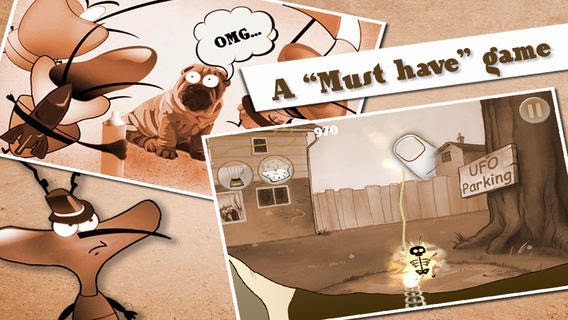
It's rough out there in the App Store world, to the extent that some game developers are attempting to pull one over on the system through some price fluctuation trickery. In a report by Mike Wehner for The Unofficial Apple Weblog, it is revealed why a simple game like The Fleas, made by Vhlamlab, would retail for $999.99. Turns out it's part of a scheme to get some eyeballs on the game by having it show up on the App Store's "Top Grossing" list. So how do they earn enough money in sales to rank on such a list? Well, that's the trick of it.
There is some back door money handling going on that results in, say, $10,000 being loaned for purchasing the game across 10 accounts. Once Apple takes their 30%, the developers have spent $3,000 to get their game on a very visible list for a few hours. At this point, the price is dropped back down to $1 to try and capitalize on legitimate sales and attempt to recoup that $3,000. It seems like an incredibly risky and shady thing to do for such a potentially small payoff, but it does happen. In fact, as Wehner notes, The Fleas is still selling for $1,000. Apparently, some people have actually bought it at that price. Madness, I say.
Labels:
apple,
blips,
ios,
marketplace,
mike wehner,
pricing,
scam,
the fleas,
tuaw
Subscribe to:
Posts (Atom)