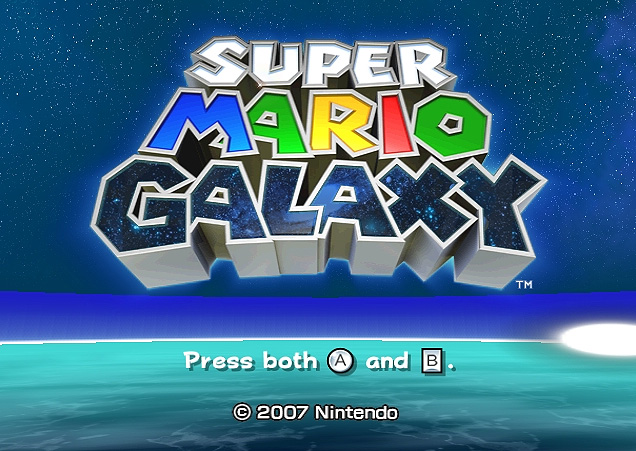
We've been told that space is the final frontier, but in the US we're witnessing the retiring of our nation's fleet of space shuttles due to scaled back government funding for manned outer space exploration. Sure, private enterprises like SpaceX (with tremendous help from NASA) will continue the bold pursuit into the unknown, but the initiative's removal from the national docket leaves it to capture the attention of those who seek it out rather than the hearts of potentially any forward-thinking citizen with an inkling for discovery. Human outer space exploration certainly inspired its fair share of scientific research and, perhaps in equal measure, the imaginations of thousands of artists, writers, and creative thinkers. I have a feeling legendary game designer Shigeru Miyamoto always wanted his Mario character to explore space too. In 2007's Super Mario Galaxy (SMG), Nintendo did just that, constructing an interplanetary mash-up of the Mushroom Kingdom and the Milky Way that serves as the perfect playground for another Mario adventure. SMG may not capitalize on the full potential of its unique gravity-defying setting, but its desire to introduce players to a kind of world they've never quite come across is clear from the outset.
Mario games have always had inexplicably floating platforms, but in SMG those platforms usually come with their own gravitational pull, meaning you can run around a spherical "planet" without fear of falling off. The general feel and aesthetic of this brand of platforming draws less from Hubble telescope images, and more from the likes of a giant mobile come to life. Think Le Petit Prince multiplied by the moon-rolling credit sequence from Katamari Damacy and you're getting there. The outcome is not that you feel as if you're traversing across vast expanses, but rather that someone dumped out a toy chest in orbit of a small satellite and asked you to make sense of it. SMG is still a platformer at heart, and to that end it is more about Mario's relationship with various floating objects than it is the zero-gravity environment that exists outside of objects' miniature atmospheres.
Given the space backdrop and the exploratory inclinations of previous polygonal Marios, I was surprised by how narrow SMG's critical path is. Game structure and mechanics in SMG are not dissimilar from 64 or Sunshine (3D platforming with a hub world containing levels with multiple individual challenges), but a much larger quantity of the levels here push you along one specific route with little-to-no room for deviation. For some games, this might be less of an issue, but 3D Mario games have a staunch precedent for collectible hunting and expansive levels with hidden nooks, making the lack thereof quite noticeable.
Let's not rag on SMG for tweaking the formula, but instead for the way it misapplies a swath of classic Mario tropes. Take coins for example. Coins in previous titles were a valued collectible item, earning you extra lives or potentially stars (symbolizing completion of a task), while also refilling lost health points. In SMG coins only exist to revitalize health and for tallying a non-rewardable high score on a per-level basis. A coin can help out in a pinch, but there's nothing to gain by "collecting" them. Or how about the "lives" system in general? Extra lives are worthless here since there's barely any reason you'll need more than the handful you begin with, plus the 5 Toad provides you every time you boot up the game. As a final deflating action, when you quit out of the game, your lives count is returned to the default quantity. Thus the idea of taking a chance on a risky jump to acquire a green 1-up mushroom always comes off as a poor value proposition. With no rare grabs to incentivize more skillful platforming I found myself hanging close to the middle of the road, which remains a perfectly engaging ride on its own, but leaves a substantial amount of underused content around the fringes.
SMG's shortcomings with story, camera, and item implementation are even more of a shame considering how impeccable the universe Nintendo has put together presents itself. There's inspired visual design for bringing the likes of lava, desert, and ice levels into the realm of fluctuating gravity. Shiny textures like brushed metal and floating troughs of water glisten with a tactile aura that will have your synesthesic senses tingling. The orchestral score dynamically swells and swoons with an emotional range that an actual Mario plotline could only dream of. I may have had issues with the controls at times, mainly due to unmanipulable camera angles, but the occasions where you bust out motion-specific commands functioned well and added some welcome variety to the standard run/jump activities. During normal gameplay scenarios, a swift Wiimote whip will trigger a spin attack for Mario, replacing the somewhat clumsy punching ability from the N64 days. Say what you will about the pervasiveness of waggle motions on the Wii, but this one doesn't require more than a quick wrist flip and the resulting action makes sense with the motion. It's like pulling the thread out from a top to get it spinning upright.
I doubt SMG is going to inspire the next generation of astronauts since it has far more in common with the world of Power Stars than real ones. The game takes an amateur-science approach to astrophysics and runs with it before all the data has been collected. This can lead to inconsistencies (which objects are "planets," and which are just platforms?) but ultimately it serves to set a tone where it's pertinent to pay attention to the action instead of stopping to contemplate why everything around you is happening and how it's possible. I mean, how is it that Mario gains the skill of breathing in the vacuum of space, but he can't breathe underwater? It's not important, and there is no answer anyway. There's an heir to a shelled dinosaur throne commanding a flying pirate ship shooting fireballs at you. It's a Mario game, so this is what you signed up for.
Showing posts with label mario. Show all posts
Wednesday, May 23, 2012
Tuesday, May 3, 2011
Review: Super Mario World (WiiVC/SNES)
Having only ever played Super Mario World in brief spats on friends' SNESes, I went into my full playthrough with skepticism. Sure, I had confidence that this would be a satisfying game, but many enthusiasts herald this as the best Mario title to date. From what I had touched previously, this hardly seemed the case. Now, with numerous castles, ghost houses, and another Bowser battle under my belt, I can see where that stunning appeal comes from, even if it doesn't strike my fancy to quite the same degree.I possess a long-standing fascination with floating platforms in games, and even though SMW doesn't really dig into that meta-game analysis, it does make you think about platform placement and level construction. Maybe it's just that the era when the platformer was the dominant game genre is behind us, but SMW is a perfect poster-child for what a well-honed 2-D platformer can achieve. This is something that modern games have a difficult time replicating without exuding nostalgia or at least coming off as largely referential to historical material. It's hard to think back to a time when Yoshi made his first appearance, and was brought on for broad gameplay variance, instead of existing as a callback or one-off power-up for use with an individual sequence.
What I liked best about SMW was the way it mixed elements of action, adventure, and puzzle solving in a fashion I don't recall another Mario game doing. The action side is largely what you'd expect if you've played a Mario game since Super Mario Bros 3. There are power-ups that let you fly and throw fireballs, and, for the most part, jumping on enemies heads still does them in quite well. That said, if you've somehow only ever played the original Mario Bros, you might be surprised at just how complex the action system has become. On the adventure tip, you navigate levels via an overworld map, complete with branching and reforming paths. The map is good at letting you know when there's something secret in a level without giving away the answers. Every level doesn't need to be completed to beat the game, but since you can save progress, you have the luxury of taking your time to explore and replay levels without fear that the electricity might go out. A significant part of the adventuring is intertwined with the heinous puzzles that meter out the exploration phases in ways that require strategic item gathering. The most difficult puzzles are totally optional, but are pretty satisfying brain teasers that taunt you to give them a shot. Part of the reason I like the puzzles so much is because at their core, they can be solved by intelligent platforming. Thus SMW doesn't balloon it's gameplay by bolting on other genre mechanics, but instead, expounds upon the intricacies of its core conceit. The result is a game that justifiably places itself on top of the platformer pile, and serves as a substantial step forward for game design at the time.
This dedication to form is what often makes Nintendo games great, but I could have done with some tweaking to particular elements of SMW. In comparison to SMB3's raccoon tail, the feather cape seems needlessly complex to control, especially in parachute mode. Coupled with the fact that none of the puzzles I completed seemed to require the gliding function (82% completion), it seems unnecessary. Then of course there's Yoshi, who I do not outright dislike, but find that I prefer not using him unless I have to. For me, using Yoshi changes the game a little too much, to the point where I'd rather just have a Yoshi game instead of putting him in a Mario one. I ended up more or less using Yoshi as a shield since you can sustain a hit while riding him and not take any damage other than losing your mount. You can wager a guess that I don't care for using the feather cape in conjunction with Yoshi either. Maybe it's the blatant disregard for physics, but, yeah, not a fan. As a small aside, the designs of most of the new enemies unique to SMW seem pretty uninspired, and it's no wonder that they haven't really shown up again since.
I appreciate Nintendo taking these risks though. They wanted to increase the complexity of their platform hopping game while also iterating on the blockbuster success of SMB3, all while positioning itself as the killer app for Nintendo's new 16-bit console. The list of games that have even been in that situation is pretty small, and shorter still for those that actually deliver on the bulk of their ambitions. SMW is such a game, but in some ways it actually feels remarkably humble. This feeling could have more to do SMW standing in contrast to the modern Mario's franchise-driven market saturation. Name a genre and there's a Mario version of it. SMW was Nintendo building upon an already solid foundation, but also venturing into innovative territory that so much iterative design is afraid to do. Sure, not everything works perfectly, but a lot of that is user preference. The brilliance of SMW's design is that there are multiple options for how to play a level, and one of those almost always feels spot on.
Subscribe to:
Posts (Atom)


